

A few years ago, talking to an AI for fun sounded like something you’d do for five minutes just to see what happened.
Today, millions of people are doing something very different.
They’re talking to AI characters every day.
They give them names. They create personalities for them. They build stories around them. Some users generate images of the same character, continue conversations for months and treat the character almost like a permanent part of their digital life.
That changes the business equation.
We’re no longer talking only about chatbots.
We’re talking about AI companions — and the market around them is growing surprisingly quickly.
According to Grand View Research, the global AI companion market was estimated at $36.8 billion in 2025. The research firm expects it to reach around $48 billion in 2026 and potentially grow to approximately $318 billion by 2033.
That’s a huge market for something that barely existed as a mainstream consumer category a few years ago.
AI companion market is entering a rapid-growth phase
Global market estimates from Grand View Research, including the 2025–2026 estimate and 2033 forecast.
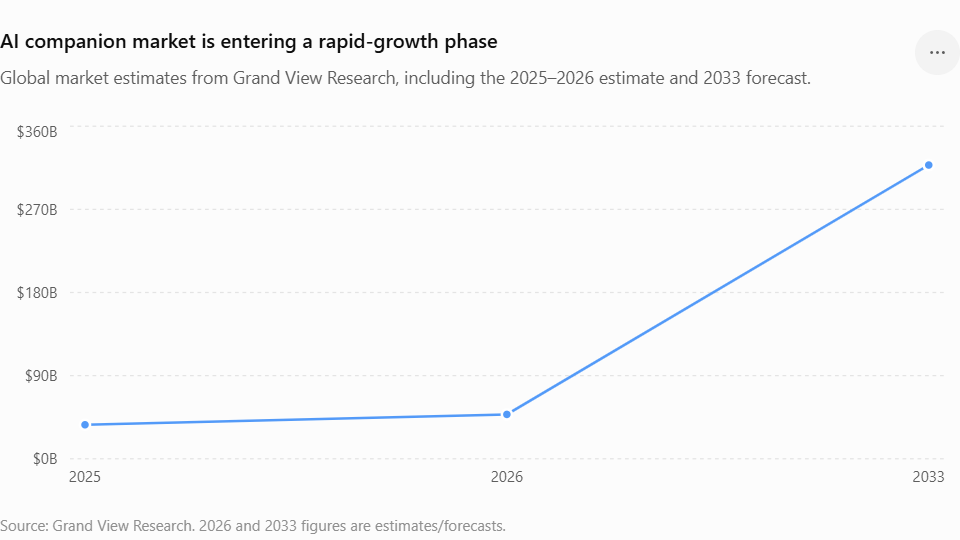
Source: Grand View Research. 2026 and 2033 figures are estimates/forecasts.
The interesting part isn’t just the size of the market.
It’s what people are actually paying for.
People Aren’t Just Paying for AI Answers Anymore

The first consumer AI boom was pretty straightforward.
- Ask a question.
- Get an answer.
- Write an email.
- Generate an image.
- Write some code.
Useful? Absolutely.
But there’s not much emotional attachment to an AI that helps you write a spreadsheet formula.
AI companions are different.
The more interesting products are built around characters.
You might choose how a character looks. Give it a personality. Decide what kind of relationship you want. Have conversations. Generate pictures. Continue the same story tomorrow.
And then come back next week.
That last part is extremely important for the business.
A normal piece of digital content is often consumed once.
An AI companion can potentially generate hundreds of interactions with the same customer.
From a subscription-business perspective, that’s a very attractive model.
The Market Is Already Global

The United States is obviously one of the biggest markets for AI companions, but it isn’t the only one worth watching.
Grand View Research estimates that the U.S. market was worth about $8.28 billion in 2025, with the figure expected to reach roughly $10.65 billion in 2026.
Europe is even larger in the same market analysis, with estimated revenue of around $9.16 billion in 2025 and approximately $12.02 billion in 2026.
Japan is smaller, but it may be one of the most culturally interesting markets.
Virtual characters aren’t exactly a new idea in Japan. Anime characters, virtual idols and digital personalities have been part of the country’s entertainment culture for years.
The arrival of generative AI adds something new: those characters can now interact rather than simply appear on a screen.
| Market | 2025 | 2026 | 2033 forecast |
| Global | $36.8B | $48.0B | $318B |
| United States | $8.28B | $10.65B | $63.22B |
| Europe | $9.16B | $12.02B | $82.15B |
| Japan | $2.17B | $2.75B | $14.64B |
These numbers refer to the broader AI companion market, not specifically adult AI or AI sex partners. That’s an important distinction because there isn’t yet a reliable public dataset that separates the adult AI segment from the rest of the industry.
But that doesn’t mean the adult segment isn’t interesting.
Quite the opposite.
The Rise of AI Partners
There’s a particularly interesting niche developing around AI partners and adult AI companions.
This market combines several industries that already generate significant consumer spending: dating, online entertainment, gaming, creator content and subscriptions.
The technology is also getting better.
An AI character can have a personality, remember previous conversations, respond in real time and generate visual content.
That’s a very different proposition from the old adult-content business.
Instead of selling a picture or video, a company can sell access to an ongoing character experience.
And that potentially creates recurring revenue.
One example is Joi.com, an 18+ AI companion platform built around customizable AI characters, conversations and generated visual content.
Joi’s 18+ AI generator is part of a broader experience where users can create and interact with personalized virtual characters rather than simply consume static content.
From a business perspective, that’s the interesting part.
The product isn’t necessarily one image.
The product is the character.
And the character can keep generating new experiences.
Why This Could Be More Important Than It Looks
There is a simple reason companies care about personalization:
personalized products are harder to replace.
Imagine you’ve spent six months using an AI companion.
You’ve given the character a personality.
You’ve established an ongoing story.
The AI knows your preferences.
You’ve generated images of the same character.
You’ve had hundreds of conversations.
Now imagine moving to another service.
You can do it, obviously.
But you’re starting again.
That creates something similar to a switching cost.
It’s not the same as being locked into an enterprise software platform, but the principle is similar. The more personal the product becomes, the less interchangeable it feels.
That’s potentially one of the strongest advantages AI companion companies can build.
The Adult AI Market Could Become a Major Niche
It’s tempting to look at AI companions and immediately focus on the adult side.
But I’d be careful with the numbers.
There is currently no trustworthy figure that says, for example, “the U.S. AI sex partner market generated $X billion in 2026.”
Anyone publishing a precise number like that without explaining the methodology should probably be treated with caution.
What we can say is that adult AI sits inside a much larger and rapidly expanding companion economy.
And the economics are attractive.
Users can pay for:
- premium AI characters
- longer conversations
- advanced memory
- image generation
- video generation
- voice interaction
- character customization
- additional credits or premium features
It’s a familiar subscription model with a very different type of product behind it.
That makes adult AI worth watching even if it remains a relatively small part of the overall companion market.
AI Companions Are Moving Beyond Text
Text was the starting point.
It probably won’t be the end point.
The next generation of AI companions is likely to combine text, voice, images and video.
Think about the difference.
A chatbot sends you a message.
An AI character can potentially speak to you, remember your previous conversation, appear visually and respond to what you say.
Suddenly it feels less like using software and more like interacting with a digital personality.
Grand View Research expects multimodal AI companions to be among the fastest-growing parts of the market.
That makes sense.
Once the same AI character can exist in text, voice and visual formats, the company behind it has more ways to monetize the same customer relationship.
One character can become an entire product ecosystem.
What Does This Mean for AI Stocks?
Here’s where things get more interesting for investors.
There aren’t many publicly traded companies that are pure-play AI companion stocks.
Most investors are therefore looking at the companies behind the infrastructure.
And that could actually be the safer way to play the trend.
Nvidia
Nvidia is the obvious infrastructure name.
AI companions need AI models.
AI models need computing power.
As AI applications scale, demand for inference and data-center hardware grows with them.
Nvidia doesn’t need to build the next successful AI girlfriend or virtual boyfriend to benefit from the industry.
It can sell the machinery used to run them.
That’s one reason AI infrastructure remains such an important investment theme.
Microsoft
Microsoft gives investors exposure through Azure, AI infrastructure and its broader software ecosystem.
The advantage here is diversification. Microsoft isn’t betting its future on AI companions.
It’s betting on AI becoming part of almost every category of software.
If AI companions become a major consumer category, that’s another source of demand for the underlying infrastructure.
Alphabet
Google has a similar position.
Alphabet has its own AI models, cloud infrastructure and huge consumer distribution.
The company also has something smaller AI startups don’t: billions of users and an enormous amount of data about how people interact with digital products.
The challenge for Alphabet and other Big Tech companies is the same one facing the entire AI sector — turning enormous AI spending into equally enormous revenue.
Meta
Meta may be particularly interesting from the consumer side.
Facebook, Instagram and WhatsApp already sit at the intersection of social interaction and digital identity.
If people become comfortable interacting with AI characters socially, Meta has obvious opportunities to integrate AI into those existing ecosystems.
Don’t Confuse AI Growth With Easy Money
This is probably the most important point for investors.
A growing market doesn’t automatically mean every company operating in it will make money.
We’ve seen this movie before.
A new technology becomes popular.
Investors pile in.
Hundreds of startups appear.
Most disappear.
A few companies become enormous.
AI companions could follow the same pattern.
The companies that survive will probably need more than a good language model.
They’ll need:
great characters + strong retention + low computing costs + good monetization + trust + regulatory compliance.
That’s a difficult combination.
And adult AI companies have an additional problem.
Payment processing, age verification, privacy, content moderation and regulation can all become major business issues.
A technically impressive product can still fail if it can’t operate reliably in major markets.
What Could the Industry Look Like by 2030?
If the current market forecasts are even approximately correct, AI companions could become a mainstream consumer category rather than a niche corner of the AI world.
The market could develop into several distinct segments.
General AI companions could compete with social and messaging platforms.
AI gaming characters could become part of RPGs and virtual worlds.
AI partners could sit somewhere between dating apps and digital entertainment.
Adult AI companions could develop into a premium subscription market of their own.
And the technology underneath all of them could become increasingly similar.
The character remembers you.
The character has a voice.
The character has an appearance.
The character has a personality.
And, most importantly, the character changes based on what you do.
That last part could be the real breakthrough.
The Biggest Change May Be Psychological, Not Technical
There’s an interesting difference between today’s AI and the internet products that came before it.
Social networks connected people with other people.
Streaming services gave people unlimited content.
Games created fictional worlds.
AI companions combine elements of all three.
They can provide content.
They can create characters.
They can respond.
And they can personalize the experience for one particular user.
That is potentially an extremely powerful consumer product.
It also explains why the industry attracts so much attention despite still being relatively young.
People aren’t necessarily looking for another app.
They’re looking for something that feels personal.
The Bottom Line
The AI companion industry is moving fast.
Grand View Research estimates a global market of around $48 billion in 2026, up from $36.8 billion in 2025, with a potential path toward hundreds of billions of dollars by 2033.
Nobody knows yet whether that forecast will prove accurate.
But the direction is hard to miss.
AI is moving from answering questions to creating experiences.
And AI companions may be one of the first consumer categories where that difference really matters.
For investors, the safest exposure may still be through the infrastructure companies building the AI economy — Nvidia, Microsoft, Alphabet, Meta and other major players.
For entrepreneurs, the opportunity may be further down the stack.
The most valuable company might not be the one with the biggest model.
It might be the one that figures out how to make people come back to the same AI character every day.
That’s a very different business from selling software.
It’s closer to entertainment, social media and subscription services all rolled into one.
And the adult AI segment is one of the clearest examples of where this model could develop.
The technology is still young. Regulation is still catching up. Consumer habits are still being formed.
But one thing already looks clear:
AI companions aren’t just a chatbot trend anymore. They’re becoming a business.